
Summer School Funding in Texas: What Districts Need to Know for 2026-2027
Texas has invested significantly in extended learning time through state legislation, and the funding landscape for summer school is more substantial than many district administrators realize. The Additional Days School Year program, in particular, is one that districts most commonly misunderstand, often assuming they do not qualify when they do.
This page covers the primary state funding sources available to Texas districts for summer school. Many of these work best when layered with federal formula funds like Title I and IDEA, covered in full on our federal funding guide.
Texas has more dedicated summer school funding than most districts are using. Our federal funding guide covers Title I, IDEA, and the documentation standards that apply no matter which state dollars you’re combining them with.
Texas Summer School Funding Overview
Texas has built one of the more substantial state-level frameworks for extended learning time in the country, primarily through the Additional Days School Year (ADSY) initiative and the accelerated instruction requirements of House Bill 2. Together these create both a funding opportunity and, in the case of HB2, a mandate that makes summer school a compliance requirement for many districts serving students in grades 3-8.
The Texas ACE program provides an additional competitive grant pathway specifically focused on summer learning quality at existing afterschool centers.
Texas places a high premium on local proof points. Districts that have implemented ADSY report strong academic results, and districts considering it for the first time benefit from connecting with peers who have already made it work. The program was updated by the 89th Legislature in 2025, so districts familiar with earlier versions should review the current framework before planning for next summer.
For federal funding that applies to Texas districts alongside these state sources, see our federal funding guide.
Additional Days School Year (ADSY): Summer School Eligibility and Use
The Additional Days School Year initiative (ADSY) is the anchor state funding source for extended learning time in Texas and the program most directly applicable to summer school. Established through House Bill 3 by the 86th Texas Legislature in 2019 and updated by the 89th Legislature in 2025, ADSY provides formula funding to support school systems in adding up to 30 additional instructional days beyond the standard 175-day minimum at eligible campuses.
ADSY is campus-specific, which means a district does not have to implement it system-wide. A district with multiple elementary campuses can pilot ADSY at two campuses while the others maintain their existing calendar. This flexibility makes it approachable for districts testing extended learning time before committing to a broader expansion.
Existing summer school programs can qualify for ADSY funding as long as the participating campus meets the same calendar and instructional-time standard as any other ADSY campus: a 180-day school year totaling at least 75,600 instructional minutes. Funding must not supplant existing federal funding for those programs.
Many districts encountering ADSY for the first time assume they do not qualify. The program is broader in its eligibility than it first appears, and the 2025 updates made it more favorable for summer programming specifically. The question to ask is not whether a district qualifies in general, but whether specific campuses meet the requirements.
The ADSY Full Year Support Grant (2025-2028) provides a separate layer of funding and technical assistance for districts planning the operational adjustments needed to qualify for ADSY formula funding. Participation in the support grant is not required to access the formula funding.
Questions to consider:
- Which campuses serve students who would benefit most from additional instructional days?
- Does the current summer program meet ADSY’s instructional minute requirements?
- Has the district reviewed the 2025 legislative updates to ADSY?
A qualifying ADSY summer program starts with campus selection. Districts identify which campuses will operate under the additional-day calendar, confirm those campuses meet the required instructional minutes per day under the 2025 update, and file for ADSY designation with TEA before the summer term begins.Documentation follows the same non-supplanting standard that governs every blended funding stack. Districts track ADSY dollars separately from federal formula funds already supporting the same students, and can show that ADSY days add instructional time rather than replace time already funded through Title I or IDEA.
Districts new to ADSY often pilot with a single campus, confirm the calendar and minute requirements hold up through a full summer term, and use that experience to plan a broader rollout the following year.
Our federal funding guide covers Title I, IDEA, and the documentation standards that apply no matter which state dollars are layered alongside them.
HB2 Accelerated Instruction: Summer School Eligibility and Use
House Bill 2 creates a summer school mandate for many Texas districts. Each time a student in grades 3-8 fails to perform satisfactorily on a state assessment in reading or math, the district is required to provide accelerated instruction in that subject area during the subsequent summer or school year.
This is not a discretionary program. For districts serving significant numbers of students who do not meet grade-level standards on state assessments, HB2 creates both a legal obligation and a funded rationale for summer programming. Districts that treat HB2 as only a compliance burden miss the opportunity to use it as a planning and budget lever that makes the case for summer school internally.
Our federal funding guide walks through how to align an HB2-compliant accelerated instruction program with ADSY and federal sources in a single cohesive summer program.
Texas ACE: Summer School Eligibility and Use
The Texas ACE High-Quality Summer Pilot strengthens summer programming at existing Texas ACE centers using the Texas Summer Learning Framework. The initiative focuses on high-quality, engaging, and aligned learning opportunities designed to prevent summer learning loss and support student development.
Texas ACE operates as a competitive grant program administered through the Texas Education Agency. Districts and community-based organizations with existing ACE centers are the primary applicants.
Districts using Texas ACE alongside federal 21st Century Community Learning Centers funding should coordinate eligibility and reporting requirements between the two, since both draw from afterschool and summer enrichment priorities. See our federal funding page for current 21st CCLC guidance.
How Texas Funding Layers with Federal Sources
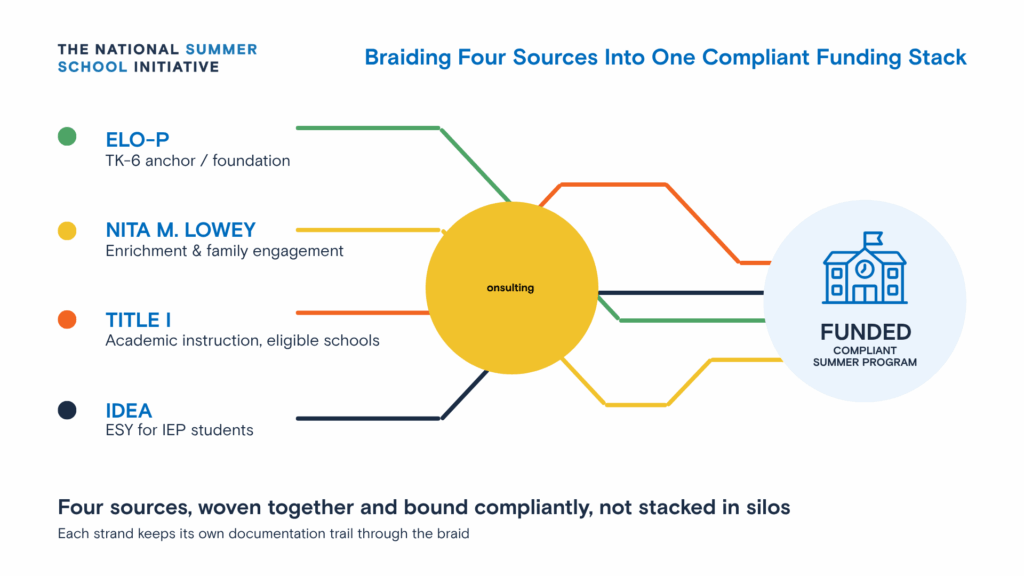
Texas’s state funding sources work best when layered alongside federal formula funds. A typical Texas summer program funding stack might draw from ADSY as the structural anchor, HB2 accelerated instruction requirements as the academic mandate and compliance rationale, Title I for supplemental academic instruction serving eligible students, and Title II-A for professional development.
With nearly a quarter of students classified as English learners, Texas districts building summer programs that serve emerging bilingual students have access to state bilingual education funding alongside ADSY and federal Title III funds for as long as Title III remains available. See our federal funding page for current Title III status.
Layering these sources without supplanting comes down to tracking what each dollar pays for and professional development they fund during the regular school year, extended into the summer term rather than duplicated by state dollars.
- ADSY funds the additional instructional days themselves.
- HB2 funds the accelerated instruction required for students who did not meet grade-level standards on state assessments.
- Title I and Title II-A continue to fund the same supplemental services
Making the internal case for this stack usually starts with HB2, since it is a compliance requirement rather than an optional funding source. Once accelerated instruction is planned around HB2, ADSY provides the additional time to deliver it well, and federal formula funds round out staffing, materials, and support services in a way that does not overlap with what state dollars already cover.
Our federal funding guide covers Title I, Title II-A, Title III, and IDEA in full, along with the documentation standards that apply across every state.
Exploring funding in other states?